
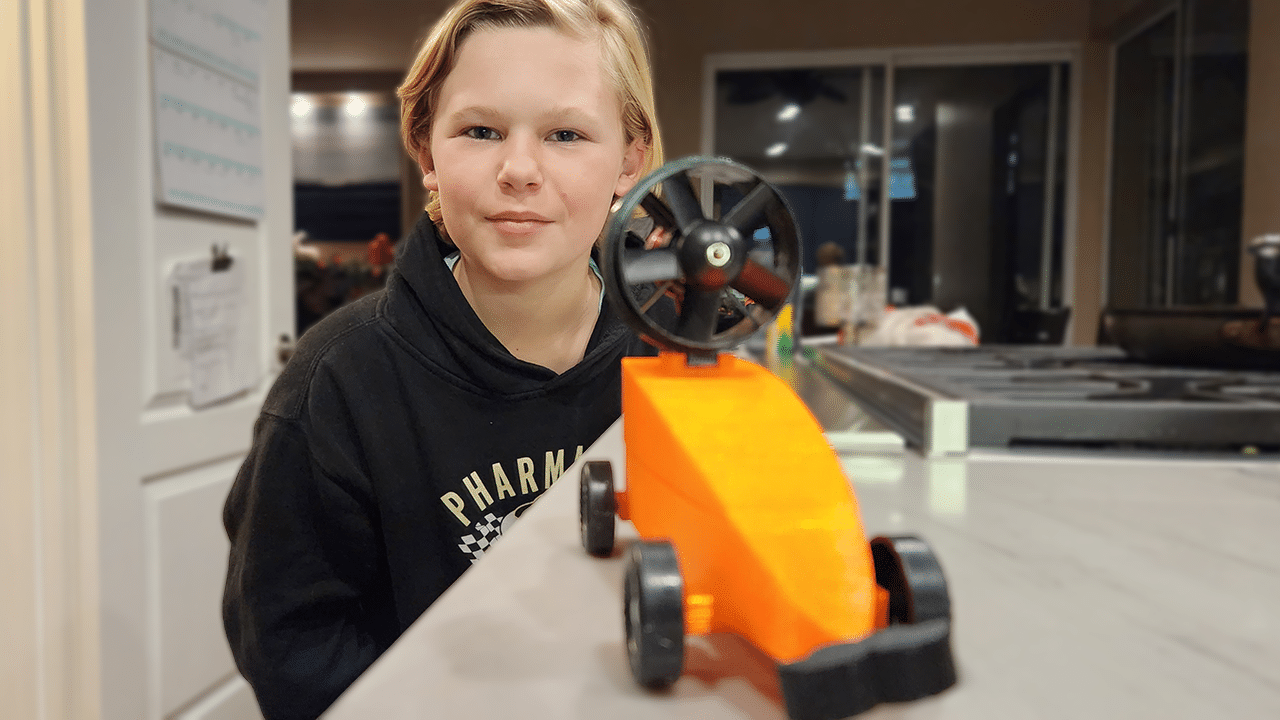
Four cars are lined up at the start line. The room filled with blue and tan shirt-wearing kids is wondering what is that big round thing on the top of a fluorescent orange tesla shaped car possibly could be. The countdown begins, 5, 4, 2, 3, 2, 1, then the gate drops. Mr. Mustach slowly drops behind just as everyone thought it was a loss, fuuuuuuuuu the engine turned on. Mr. Mustach races past the three other cars for a finish in about a second. Breaking the computer program and coming in one and a half seconds faster than all the others.
I have two sons in scouting, one in cub scouts, and last year my oldest son bridged to boy scouts. Our pack’s adults and older siblings are allowed to compete in a no-rules pinewood derby race. Like many of your kids, my son is obsessed with Mark Rober’s videos on youtube, especially his episode about pinewood derby physicals and when he builds his ultra-fast car using a CO2 cartridge as a propellant. As we attached that episode, my son said, “That is so cool!” I replied, “I think we can do that only better”. After some discussion, we concluded that the CO2 cartage model would be too dangerous since it could not be slowed. We discussed putting a rocket engine rather than a cartridge, which was worse than the CO2. We concluded that building a car with a duct fan controlled by a microcontroller triggered by the fence dropping would be best.
I saw this as a great opportunity to work with my son to teach him about the engineering design process and let him be hands-on to help create something from a concept to a reality. Selfishly, I had always been looking for a reason to buy a 3D printer, and this was just the opportunity to convince my wife that it was a need, not a want. Armed with some CAD youtube videos, a new 3D printer, an Arduino nano, a battery, and the all-important duct fan in hand, we start creating.
Throughout the build, I taught him about CAD and how to design iteratively to understand the physicals and add features to the design. We printed six prototype copies of the car before coming to the final design. We built the prototype drive system using an Arduino Uno R3, and he learned about pull-up resistors, brushless motor controllers, state machines, firmware flashing, and iterative testing. We soldered it all together, replacing the Adruino Uno R3 with an Arduino Nano, and crammed it all into the belly of the car.
With pinewood derbies, you are not allowed to run the car on the track before race day. So you never know how your car will perform until the first race. That’s one of the things that makes racing so fun. You never know what is going to happen. We had calculated that about a second for thrust would get us the maximum performance while still benign able to turn off the fan before the end of the race. On the first run, no one knew what was about to happen until they heard the fan kick in the saw the car fly down the track. It was a huge success. The kids all loved it, especially my son, who was the topic of the bussing crowd.
It is important to find projects that interest the people around you and teach them when they are ready to listen. My son learned a lot about how hardware and software interact, he learned how different disciplines on a team of engineers work together to create. Most importantly, he learned that he could turn ideas into reality with patience, persistence, and passion.